
When Do Newborn Babies See Clearly? A Doctor’s Month-by-Month Guide to Baby Vision
Quick Summary: Newborn Vision Timeline
When Do Newborns Open Their Eyes After Birth?
Most newborn babies open their eyes within a few minutes to a few hours after birth. However, it is completely normal for a baby to keep their eyes closed or swollen shut during the first 24 to 48 hours due to facial pressure during delivery or temporary eyelid puffiness.
Why Do Newborns Keep Their Eyes Closed So Much?
In the first few weeks, babies sleep 16 to 18 hours a day. When awake, they often keep their eyes partially closed or squint because:
Their retina and optic nerves are still developing.
Their eyes are extremely sensitive to bright indoor lighting.
They lack the muscle strength to keep eyelids open for long periods.
How Long Does It Take for a Newborn Baby to See Clearly?
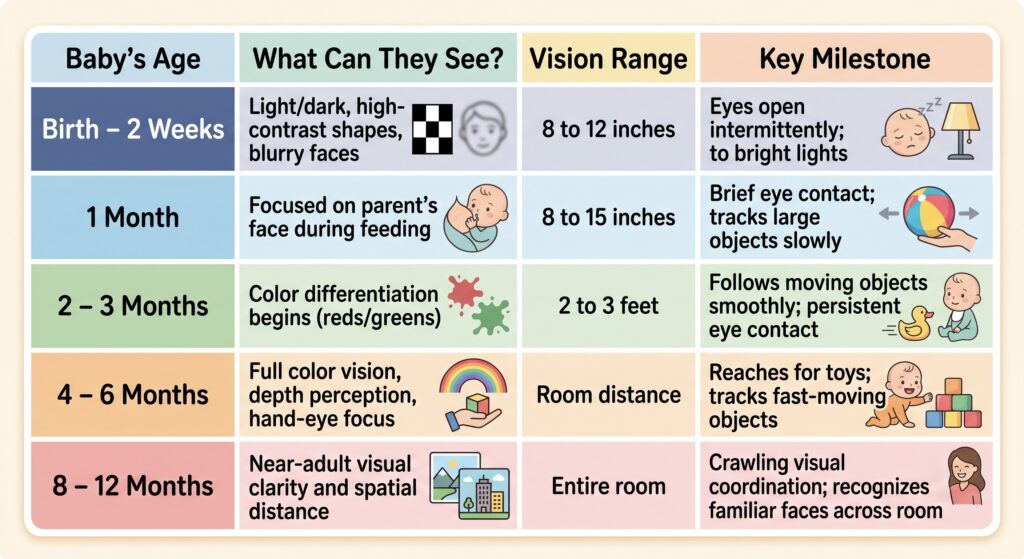
At birth, a baby’s visual acuity is roughly 6/60 —meaning they see the world as a soft, blurry image in shades of gray, black, and white.
Focus Distance: A newborn can only focus on objects 8 to 12 inches away from their face (the exact distance between a mother’s face and her baby while nursing or cradle-holding).
Clear Vision Milestone: A baby starts to see faces and high-contrast objects with reasonable clarity around 2 to 3 months of age.
Adult-Level Clarity: Full visual acuity (6/6 vision) and complete depth perception develop around 12 to 18 months of age
Month-by-Month Newborn Vision Development
1. The First 4 Weeks (0 – 1 Month)
During the first month, a baby’s eyes do not work together efficiently. You may notice their eyes occasionally cross or drift outward—this is normal as eye muscles strengthen.
Colors: They see primarily black, white, and high-contrast geometric patterns.
Facial Recognition: They recognize their parents by voice and scent first, but love staring at hairline contours and eyes.
2. Months 2 to 3: The Eye Contact Phase
Between 6 to 8 weeks, a major neurological milestone occurs: true visual tracking and eye contact.
The baby starts following moving objects smoothly from side to side.
Primary color perception begins, starting with red and green.
The eyes start alignment; wandering/crossing should lessen significantly.
3. Months 4 to 6: Depth Perception & Hand-Eye Coordination
By 5 months, a baby’s brain learns to combine images from both eyes into a single 3D view (binocular vision).
They can judge distances accurately to reach out and grab toys.
They track faster movements and recognize familiar objects across a room.
Frequently Asked Questions (Parent FAQ)
A baby can focus on near faces (8–12 inches) within 7 to 10 days after birth. Clearer intermediate vision and color recognition develop around 60 to 90 days (2 to 3 months).
By week 3 or 4, as the baby adapts to room light and sleep cycles stabilize, they remain wide awake with open eyes for longer stretches, especially during feeding and quiet alert states.
Koshish karein ki baby ke paas (8-12 inch door) rehkar baat karein. Navjat shishu ko janam ke waqt se hi dhundhla dikhta hai, lekin 1 se 2 mahine ke andar baby chehre pehchanna aur eye contact banana shuru kar deta hai. 3 mahine tak baby objects ko follow karne lagta hai.
Schedule a checkup with a pediatric ophthalmologist if you notice any of the following warning signs:
Persistent eye-crossing or drifting outward after 3 to 4 months of age.
Constant watery eyes, heavy discharge, or crusting on eyelids.
A white or grayish opacity/glow in the baby’s pupil (leukocoria).
Extreme sensitivity to light or rapid, rhythmic eye shaking (nystagmus).
The baby does not make eye contact or follow objects by 3 months of age.
Don’t Ignore Babies Eyesight
Early eye examinations can help detect eye problems and support healthier long-term vision for your child.