
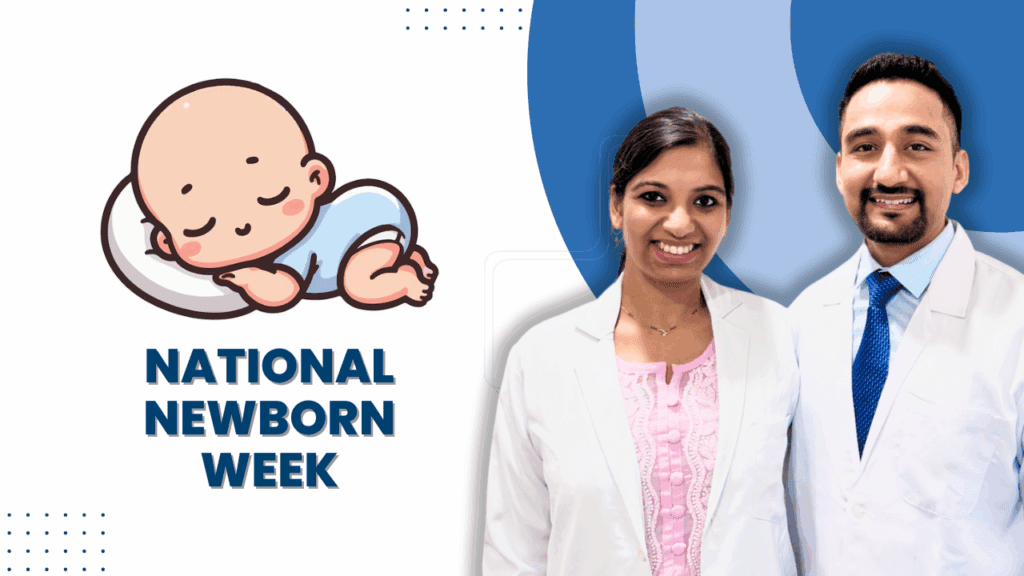
National Newborn Week is celebrated in India every year from November 15 to 21. The aim is to create awareness about newborn health, early care, and timely screenings. One very important—but often ignored—aspect of newborn health is eye screening.
Most parents take their baby for vaccinations, weight checks, and routine pediatric visits, but eye examination is usually missed. In reality, the first few weeks of life are critical for a child’s vision. Some eye conditions can cause permanent blindness if not detected early.
In this detailed guide, we explain:
• Why newborn eye screening is important
• What eye problems newborns can have
• When to meet an eye specialist
• Which babies need urgent ROP screening
• Treatment options in simple language
• FAQs people search on Google
This entire blog is written with inputs from:
• Dr Saurabh Deshmukh – leading retina specialist in Bhopal, expert in ROP, cataract, uveitis, neuro-ophthalmology
• Dr Krati Gupta – respected eye specialist in Bhopal, expert in cornea, cataract, LASIK, dry eye & ocular surface diseases
Why eye screening is important for newborns
At birth, a baby’s visual system is still developing. Any untreated problem in the first few weeks can affect vision permanently. Many eye issues do not show external symptoms early, so parents may not notice anything wrong.
Early screening helps in identifying:
• ROP (Retinopathy of Prematurity)
• Congenital cataract
• Corneal infections
• Squint (misalignment)
• Glaucoma in newborns
• Retinal diseases
• Blocked tear duct
These conditions are treatable—but only if diagnosed in time.
Common newborn eye conditions
1. ROP – Retinopathy of Prematurity
One of the biggest reasons we observe National Newborn Week is to raise awareness about ROP.
ROP occurs in:
• Premature babies (born before 34 weeks)
• Low birth-weight babies (< 2000 g)
• Babies admitted in NICU
If not detected early, ROP can cause permanent blindness.
Who should be screened?
All premature babies must get their first ROP screening within 30 days after birth.
Dr Saurabh Deshmukh specializes in ROP management in Bhopal.
2. Congenital Cataract
Some babies are born with cataracts. It can severely affect vision development.
Early surgery is needed—usually within the first few months.
3. Corneal infections
Infections after birth can cause:
• Redness
• Watering
• White spots in the eye
Corneal problems can lead to permanent scarring. Dr Krati Gupta specializes in corneal diseases in newborns and children.
4. Blocked Tear Duct
Common signs:
• Constant watering
• Sticky discharge
Most cases improve with massage, but some require treatment.
5. Squint / Misaligned eyes
Some newborns appear cross-eyed. But if squint persists beyond 3–4 months, consult an eye specialist.
Warning signs parents should never ignore
• White reflex instead of red in photos
• Baby not looking at faces by 2–3 months
• Constant watering
• Red or swollen eye
• Baby keeps eyes closed
• Baby not tracking moving objects
If any of these signs appear, meet an eye specialist immediately.
Who should examine newborns?
A trained ophthalmologist, preferably with experience in:
• Retina
• Cornea
• Pediatric eye care
• ROP
• Neuro-ophthalmology
You have both specialists in one place:
• Dr Saurabh Deshmukh – Retina, ROP, Neuro Ophthalmology
• Dr Krati Gupta – Cornea, Cataract, LASIK, Ocular Surface
Frequently Asked Questions (FAQs)
1. Is newborn eye screening painful?
No. It is quick and safe.
2. Can ROP be cured?
Yes—if treated early with laser or injections.
3. Why do some babies have white pupils?
Possible cataract or serious retinal disease. Needs urgent attention.
4. My baby is full term. Do we still need screening?
If baby has watering, redness, or not tracking objects—yes.
5. Can newborns get glasses?
Yes, if high number is detected, glasses can be given.
Conclusion
National Newborn Week is a reminder to every parent:
👉 Your baby’s eyes deserve an early check-up.
Timely screening prevents blindness, especially in premature babies.
Book your newborn’s first eye exam today.